
Transit Vehicles Reference Designs
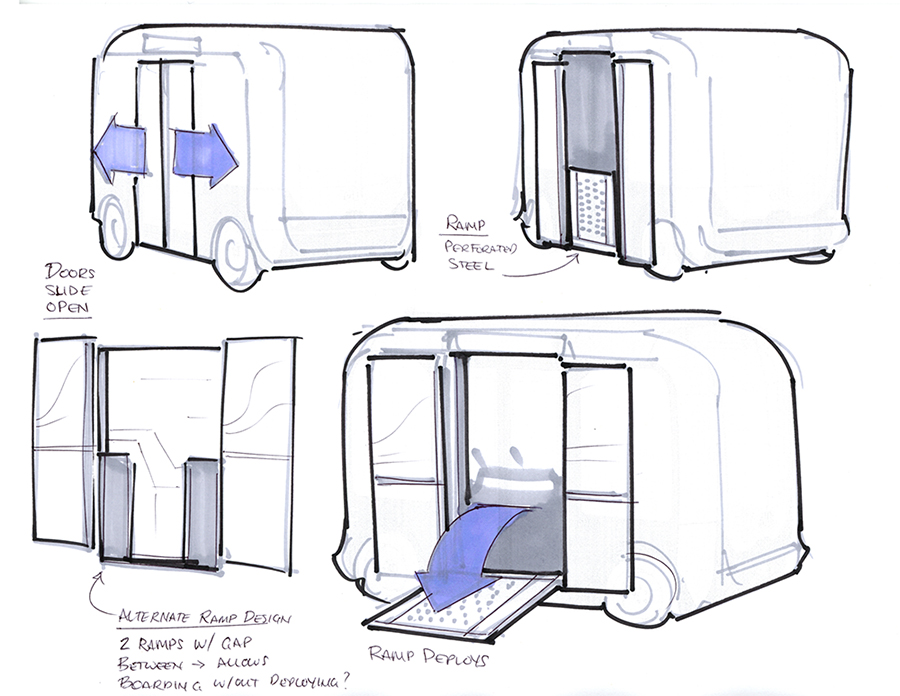
Shared autonomous vehicles operated by transportation networks have the potential to increase accessibility to the community for people with disabilities significantly by providing on demand door to door service like paratransit. Using a universal design model for service delivery and vehicle design, they can serve all riders, with no additional charge for accessibility. They could substitute for expensive private vehicles that have to be customized for use by people with wheeled mobility devices. And, they also can eliminate the need to hunt for accessible parking or manage recharging at home.
As autonomous vehicles come on line it is important that they are fully accessible. Small vehicles holding 4-6 passengers are most promising for community wide deployment with door to door service. Current designs for small autonomous vehicles, however, do not provide a level of accessibility that can be use effectively by people with disabilities without assistance.
The primary design barrier for accessibility to small autonomous vehicles is providing safe and accessible entry and exit. IDEA Center research demonstrated that a 1:8 slope is the maximum for accessible ramps. But current vehicle designs have floor heights that require much steeper ramps. Further, the engineering of battery powered shared vehicles leads to location of the heavy batteries in the floor structure at the center of the vehicle, precisely where the ramp should be located for good access. The design concept presented here is based on current shared vehicle concepts designed as small shuttle buses. By wrapping the battery around the lift, the floor can be lowered to a minimum height.
A second major design barrier is the small floor are of busses this size. High floor small buses use lifts to provide access. Although low floor shuttle buses are available, they are much more expensive than high floor buses and only have room for one wheeled mobility user. Further, they do not have automated securement, although such systems are available. The design concept uses convertible seating to create enough clear floor space to accommodate two wheeled mobility devices. To accomplish this, the concept utilizes convertible, or “jump” seats to provide the space for maneuvering into the automated securement devices.
A third barrier to the deployment of autonomous vehicles in transportation network services is the lack of accessible interaction with the vehicle. Many systems need to be considered for automatic operation. Accessing the vehicle requires finding it easily without vision or poor vision, accessing the vehicle without use of hands, and protection against misuse and victimization by others. Systems inside the passenger compartment are needed to provide information like schedule changes, route progress, infotainment and safe door operation. The design concept identifies the many features that need to be addressed and recommends solutions without being proscriptive.
This reference design is offered to the industry to provide direction as vehicle manufacturers and transportation service providers plan for the next generation of small autonomous vehicles. The features proposed are based on research conducted over the last five years and interaction with industry representatives. The IDEA Center is available to consult with manufacturers and operators to bring these ideas to fruition and evaluate them in use.